Professional·One-stop Services
Get customized solution and favorable quotes here: +86 13526692320

When you are about to pay a deposit for a pyrolysis machine, the real question is not "whose website looks best" but "who can I actually verify?" A supplier worth the money should let you confirm nine things: its legal entity and whether it owns a factory, the validity of its certificates, whether the machine will meet your local emission rules, its reactor materials and patents, its technical team and sample-testing ability, projects matching your feedstock, the service terms written into the contract, and its real-world reputation. None of this needs special expertise—only a willingness to ask and a supplier confident enough to answer.
DOING ECO's legal entity is Henan Doing Environmental Protection Technology Co., Ltd (part of Doing Holdings), with a sales office in Zhengzhou and its own factory in Jiaozuo, Henan. The checks below are the ones DOING ECO invites you to apply to it as well—if any supplier cannot meet them, the gap itself is your answer.
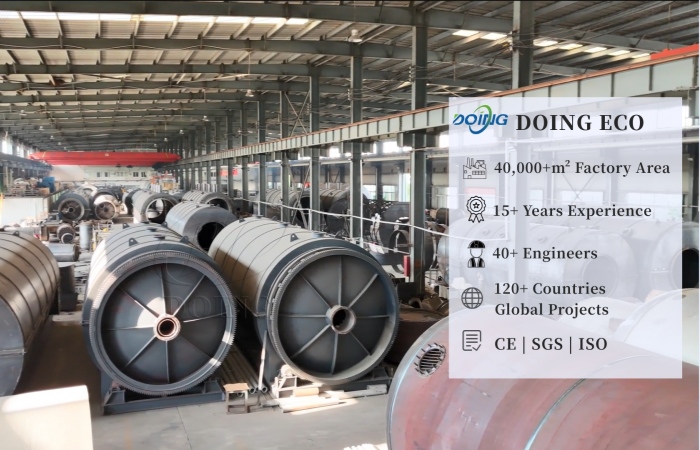
DOING ECO pyrolysis machine manufacturer brief introduction
| Item | DOING ECO |
| Legal entity | Henan Doing Environmental Protection Technology Co., Ltd (part of Doing Holdings) |
| Location | Sales office in Zhengzhou; own factory in Jiaozuo, Henan, China(By 2026, the total factory area has exceeded 40,000 square meters. ) |
| Product scope | Pyrolysis machines for recycling solid hazardous wastes like waste tire, plastic, oil sludge, oil-based drilling cuttingsaluminum plastic, etc. |
| Certifications | ISO 9001, ISO 14001, CE (Machinery / Low Voltage / ATEX / Pressure Equipment directives), SGS third-party inspection, National High-Tech Enterprise,Innovative SMEs in Henan Province |
| Patents | 49+ Patents (including patented safety and environmental-protection devices) |
| Market | Customers in more than 120 countries and regions |
| Officially Certified | Selected for the recommended Catalogue of Henan Energy-saving, Water-saving, and Solid Waste Comprehensive Utilization Technologies and Equipment for the Industrial Sector |
| Pre-sales | Free raw-material sample testing with report; 2D/3D site layout, Third-party factory audit |
| After-sales | Engineer-led installation & commissioning, on-site training, 1-year warranty, lifetime spare parts at cost price |
The company behind the machine matters more than the machine photo. Ask for the registered entity name and check it appears consistently on the contract, the invoice, the website footer and the certificates. A trading company reselling under its own brand often shows mismatched names or no traceable factory.
Then verify the factory itself. A manufacturer should welcome a visit or a live video walk-through of the production floor—welding, assembly, test runs—rather than only product renderings.
| If you see… | …it usually means |
| Same company name across contract, invoice, site and certificates | A consistent, verifiable entity |
| A factory address on a map, open to visits or video | Owns or controls production |
| Only an office address, or refusal to show the floor | Likely a middleman |
| Many unrelated brands for sale | A reseller, not the builder |
DOING ECO's factory is in Jiaozuo, Henan, and the company invites buyers to visit before ordering or to join a live video tour if travel is not possible.
Video overview of DOING ECO pyrolysis machine manufacturing factory
The certificates that matter for a pyrolysis machine are ISO 9001 (quality management), ISO 14001 (environmental management), CE marking for the EU market—typically covering the Machinery, Low Voltage, ATEX and Pressure Equipment directives—and third-party inspection such as SGS.
Certificates are easy to display and easy to fake, so verify the numbers rather than the logo. Ask for copies with certificate numbers, check those numbers with the issuing body or registrar, and confirm the scope covers the exact model and configuration you are buying.
DOING ECO holds the ISO and CE certifications above and SGS third-party inspection, and provides certificate copies and report numbers on request.
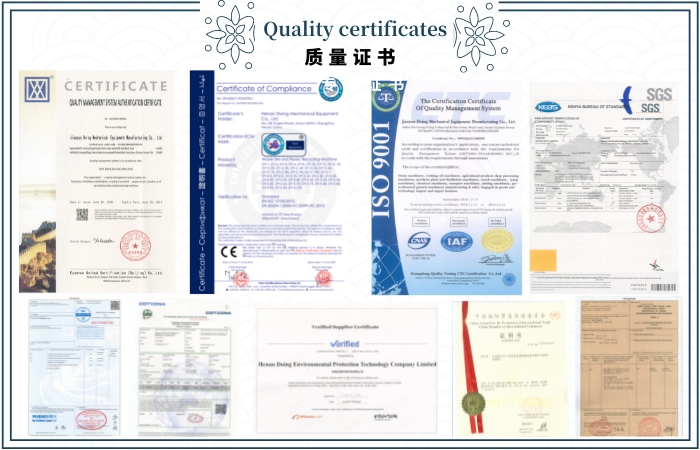
Certifications for DOING ECO pyrolysis machine
No machine is "compliant everywhere." Emission limits differ by country and even between industrial zones, and the four pollutants most projects must control are sulfur dioxide (SO₂), nitrogen oxides (NOx), particulate matter and volatile organic compounds (VOCs). The useful question is not "is it green?" but "which configuration do you propose so it passes where I operate?"
| Scale | Typical control configuration |
| About 100 kg–3 tons/day | Lower emissions; may fall below treatment thresholds in some regions |
| About 5–20 tons/day | Exhaust gas purification plus a desulfurization tower |
| About 30–50 tons/day | Full suite: dust collector, desulfurization (often >90% SO₂ removal), SCR denitration, combustion chamber, activated carbon |
| Where continuous monitoring is required | Optional CEMS tracking SO₂, NOx, particulate matter, oxygen and flow |
A manufacturer should ask for your local standards before quoting. DOING ECO configures emission control per the customer's site—reusing cleaned non-condensable gas as supplementary fuel in a closed loop to suppress VOCs at the source, then treating flue gas through the stages above. CEMS is available as an option, and third-party flue gas test reports can be supplied.
Video introduction to the DOING ECO pyrolysis machine exhaust gas purification systems
The reactor decides how the machine behaves over years. For tire and plastic feedstocks, pressure-vessel steels such as Q245R or Q345R are the norm; corrosive feedstocks like oil sludge or coal tar call for a stainless-steel composite layer or lining (for example 304/306S). Ask the reactor material grade, plate thickness, and how welding is controlled—a supplier that cannot answer does not control its own manufacturing.
DOING ECO builds its reactors from Q245R/Q345R pressure-vessel steel with a stainless-steel composite layer, 14–18 mm thick, and a 304/306S lining where the feedstock is corrosive.
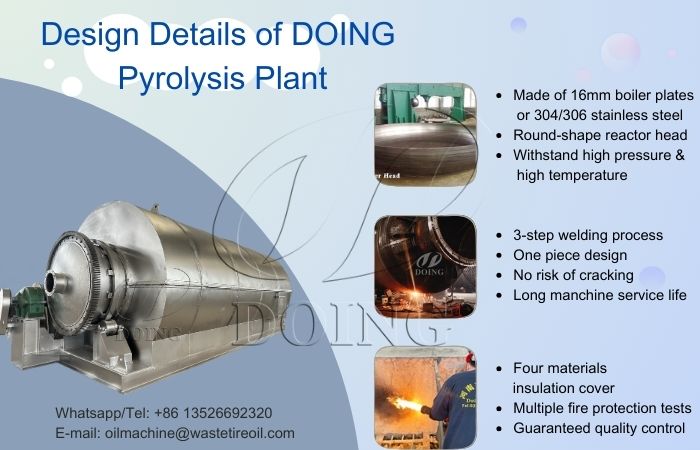
DOING ECO pyrolysis machine manufacturing details
Patents are a second signal. DOING ECO holds more than 49 patents (till 2026), including patented safety and environmental-protection devices; ask any manufacturer for patent numbers and check them in the relevant patent database.
The technical team is the third. A capable supplier should be able to test your raw material and show you the result before you commit. DOING ECO offers small-scale laboratory testing of a customer's sample, returning a report on treatment effect, oil yield and product quality, and can provide a process flow diagram and 2D/3D site layout as part of the proposal.
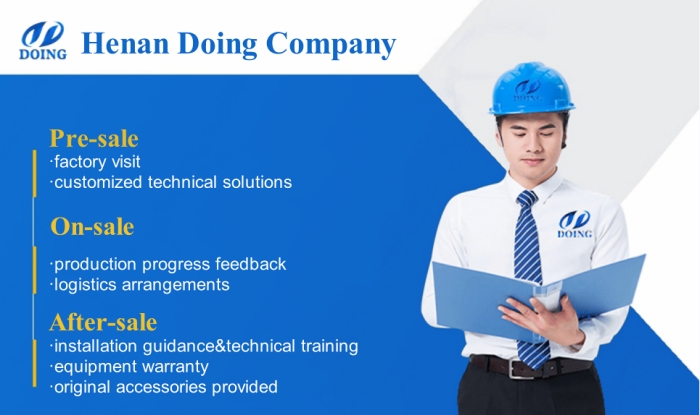
Services provided by DOING ECO pyrolysis machine manufacturer
Generic case photos prove little. Ask for projects with the same feedstock and capacity as yours, and for videos or reference contacts. The table below lists published DOING ECO projects chosen to cover different feedstocks and capacities:
| Project | Configuration | What it shows |
| Kenya | 15 tons/day batch pyrolysis machine | An asphalt-mixing-plant owner using the pyrolysis oil as boiler fuel; the order came through an existing customer’s referral |
| Myanmar | 3 × 15 tons/day batch machines (45 tons/day total) | A lime-factory owner using the oil (calorific value 42–45 MJ/kg) for self-supplied fuel; side slag discharge, automatic feeding, heavy-oil burner; inquiry 2023-01, contract 2024-06, shipment 2024-09, completion 2025-01 |
| India | 50 tons/day fully continuous machine | Rubber-powder feedstock, PLC temperature control at 300–600 °C, front-end steel-wire removal recovering over 98% of the wire |
| China (Inner Mongolia) | 20 tons/day electric-heated oil-based drilling cuttings unit | Oilfield service client; treated solids below 0.3% residual oil; custom anti-coking scraping and furnace lining for a difficult feedstock |
More DOING ECO cases are published on the official project pages. If a supplier cannot show a project close to yours, ask directly which one is nearest and whether you can verify it.
DOING ECO semi-continuous oil sludge pyrolysis machine project in Malaysia
After-sales is a set of clauses, not a promise. Before signing, confirm at least: the payment schedule (a deposit to start production, balance before shipment), delivery time and who bears delay, engineer-led installation and commissioning with a real-material test run, operator training, the warranty period and what it covers, and the spare-parts supply policy.
DOING ECO writes all of these into the contract before production starts. Its standard terms include a typical lead time of about 40 days for a standard machine and about three months for a fully continuous line, on-site installation and training of about one month, a one-year warranty on manufacturing defects, and lifelong spare parts at cost price; training covers operation, maintenance, safety and troubleshooting, delivered on site and reinforced with remote support.
Search the brand with words like "review" or "company" and read both sides. Look at the manufacturer's own video channels—running machines are harder to fake than website copy—and ask for a customer in your region or industry. Repeat orders and referrals are the strongest signals. DOING ECO notes customers in more than 120 countries and referral-driven orders such as the Kenya project above, and maintains public video channels showing operating machines and project sites.
| Red flag | Simpler test |
| Company name differs across documents | Ask for the registered entity and verify it |
| Refuses factory visits or video | Insist on a floor walk-through |
| Cases only as text, no video or contacts | Request one verifiable same-type case |
| Demands full advance payment to a personal account | Use a contract with deposit/balance terms |
| Certificates without traceable numbers | Cross-check with the issuer |
| Promises fixed yield, “zero emissions” or “100% conversion” | Ask for a yield range from a test of your material |
| Cannot name reactor material or welding method | Request drawings and specifications |
| Warranty only verbal | Require written clauses |
| Says it “meets all standards everywhere” | Send your local standards and ask for a configuration |
| Low quote plus “decide today” pressure | Compare complete offers; test the material first |
DOING ECO turns every check above into something you can do before paying. You can send a raw material sample for free laboratory testing with a report; visit the Jiaozuo factory or join a live video tour; request certificate copies, patent information and third-party flue gas test reports; ask for case videos matching your feedstock; and have all commercial terms written into the contract.
Send a clear brief so the supplier can quote accurately: your feedstock type and daily volume, the country and the specific emission limits you must meet, your target products and how you will use them, and your site constraints such as space, power supply and labor. A manufacturer that asks for these before quoting is thinking about your project, not just its catalogue.
Compare like for like. Ask each supplier to list exactly what the price includes—reactor, condensation, emission system, control type, installation, training, spare parts and shipping—then compare the scopes, not just the totals. A low number that quietly drops the emission system or the commissioning service is not a saving; it is a cost you will pay later as permits, downtime or retrofits.
Size and age are weak signals on their own. A young workshop that opens its factory, shows patent numbers, runs your sample and names contactable customers can be a safer choice than a large reseller that controls none of its supply chain. Weigh the verifiable evidence—entity, certificates, cases, contract terms—over the year count on the "About" page.
Expect the supplier's engineers to assemble and test the machine on site, usually running it with your actual feedstock until it reaches stable operation, then train your operators on routine use, maintenance and emergency response. Confirm in the contract who covers travel and how "successful commissioning" is defined, so the handover is measurable rather than a handshake.
As a general practice for pyrolysis machines, filters, valves and scrubbers are inspected weekly and given a deeper clean about every quarter to keep treatment efficiency up; operators trained on these routines reduce human-error risk. Ask the manufacturer for the maintenance schedule specific to the configuration you buy, and confirm spare-parts availability before you need them.
Request the certificate copies with numbers listed in the at-a-glance table above and check them with the issuing bodies; book a visit or live video tour of the Jiaozuo factory; send a raw-material sample for the free laboratory test; and ask for a published case closest to your project (the Kenya, Myanmar, India and Inner Mongolia projects are documented with configurations and timelines). DOING ECO puts the payment schedule, delivery, commissioning, training, warranty and spare-parts terms into the written contract before production begins.
To start, send four things: your raw material and planned daily capacity, your country and local emission standards, your target products, and your site conditions. A project manager will respond with a solution and quotation.
Leave A Message
Leave A Message