Professional·One-stop Services
Get customized solution and favorable quotes here: +86 13526692320

No. The non-standard diesel produced by a waste engine oil refining machine is a fuel, while base oil is the raw material that finished lubricants are blended from. The machine is built to make oil burn well: dewatering protects the heating system, distillation cuts the diesel boiling range away from the heavier residue, and polishing improves colour, odour and storage stability. Base oil is judged by how it holds a lubricating film under heat and load, not by how it burns, so this machine neither makes it nor replaces it. Both products start from the same drum of waste oil and end up in different industries. Decide what your end product is first, then choose the process.
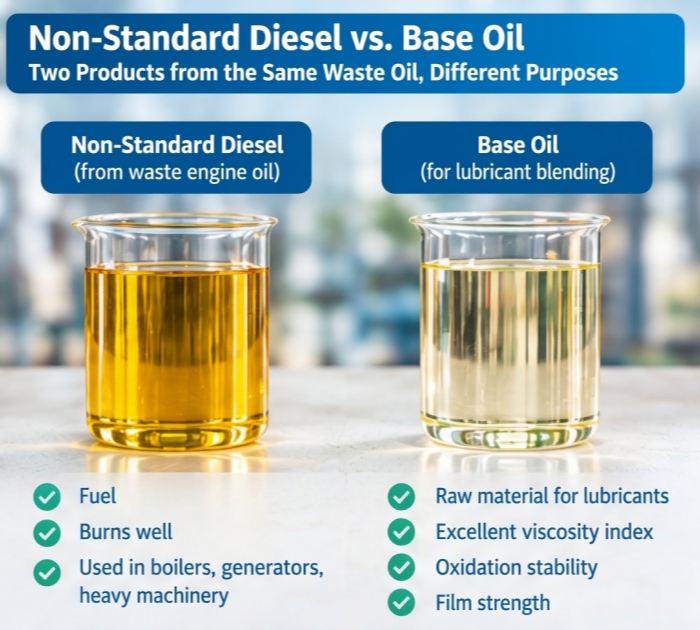
Non-standard diesel and base oil serve different purposes
Base oil is the main ingredient in a finished lubricant and the bulk of what a blender buys. The blender adds detergents, anti-wear agents and pour-point depressants, then fills the result into engine oil, hydraulic oil, gear oil or grease. Because the base oil sets the ceiling for what the additives can achieve, blenders buy it against a specification, not by colour or by price alone.
Viscosity index comes first. Every oil thins as it heats up and thickens as it cools, and a high index simply means the change is small. That is what lets one grade protect an engine at a cold start and still hold pressure on a long climb with a loaded trailer. An oil whose viscosity swings too far is either too thin when hot or too stiff to circulate when cold.
Oxidation stability is the second. Hot oil in contact with air reacts slowly with oxygen, forming acids, varnish and sludge, so a stock that resists this lasts longer in service. The third is film strength: under load the oil has to stay in the contact zone instead of being squeezed out. Wear protection depends on that film holding, not on how well the oil burns.
None of the three properties is measured by setting a sample alight. They are measured in a laboratory against lubricant standards, and a batch that misses the specification is rejected before it ever reaches a blender's tank.
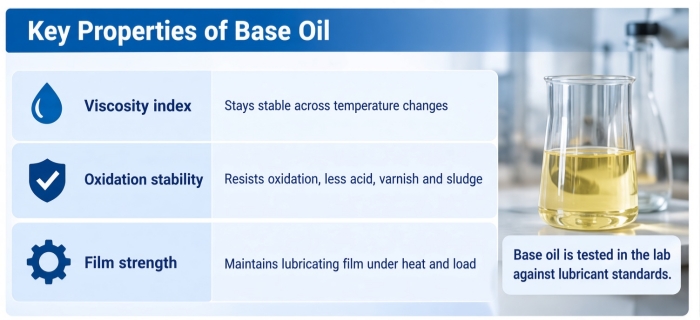
Key properties of base oil
A waste engine oil refining machine works in the opposite direction: it treats waste oil as a fuel source. Water and solids come out first, because water in the feed foams under heat, slows the rise in temperature and carries acidic compounds forward into the column. The dried oil is then heated and separated by boiling point, with the diesel-range cut taken off as vapour and a heavy residue left at the bottom.
That cut is condensed, then polished with a catalyst or clay to reduce colour, odour and reactive compounds. What leaves the system is non-standard diesel, a heavy residue similar to asphalt, and a small stream of combustible gas that is piped back to the burner. Every step serves combustion and storage, not lubrication.
| Stage | What happens | What it decides |
|---|---|---|
| Dewatering and filtration | Free water and solids removed before heating | Stable heating, less corrosion, fewer blockages |
| Distillation | Oil separated by boiling point into a diesel-range cut and a heavy residue | How much diesel-range oil you recover and how heavy the residue is |
| Catalytic or clay polishing | Colour, odour and reactive compounds reduced | Storage stability and how cleanly the fuel burns |
| Condensation and cooling | Vapour turned back into liquid and brought to handling temperature | A product that can be stored, moved and sold |
DOING ECO builds this machine in two routes. The traditional route refines with acid and alkali, followed by clay filtration. The newer route is catalytic distillation: it uses a solid catalyst and avoids the acid-alkali wastewater that the traditional liquid route generates.
Both routes deliver non-standard diesel for boilers, heavy machinery and diesel generators, and the newer route gives somewhat better diesel quality. Neither route turns the oil into base oil, and neither is sold as a base oil plant.
Swapped, the two products fail in opposite ways. Pour non-standard diesel where a lubricant belongs and the film is far too thin: it runs off hot metal, gives little protection against wear and oxidizes into varnish within a short service interval. Burn base oil instead, and its high flash point and heavy body stop it from atomizing, so combustion is incomplete and carbon builds up in the furnace or engine.
Nor does blending close the gap. Adding a share of non-standard diesel to a lubricant dilutes the properties the base oil was bought for, and no additive package restores a film that the stock itself cannot form. The limit sits in the stock, not in the mixing ratio.
| Comparing them side by side | Non-standard diesel | Base oil |
|---|---|---|
| What it is | A fuel oil optimized for combustion | The stock that lubricants are blended from |
| Key properties | Calorific value, flash point, distillation range | Viscosity index, oxidation stability, film strength |
| How it is judged | Burns cleanly, leaves no harmful deposits | Survives friction, heat and long service |
| If you swap them | As a lubricant: too thin, no film, fast oxidation | As a fuel: poor atomization, carbon deposits |
They come from the same drum of waste engine oil, which is exactly why the confusion exists. Refining then sends them in different directions: one is optimized for the firebox, the other is engineered for the bearing. Using one as a stand-in for the other is not a compromise, it is a misuse.
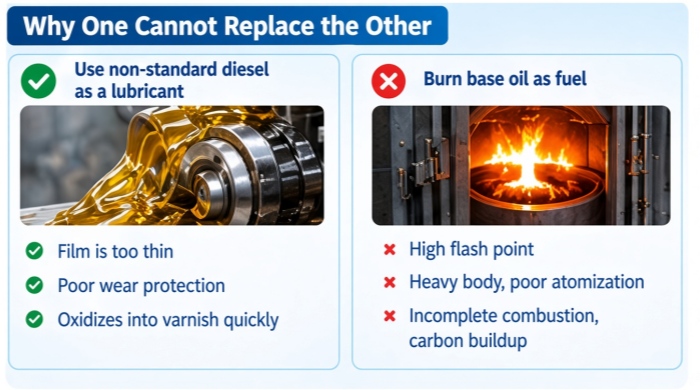
Fuel oil and base oil have different performance requirements
The wider industry does have routes that turn lower-value oils into base oil stock, such as deep hydrofining. Those are plants of a different class, with investment and operating requirements far above a waste engine oil refining machine, and their output still has to pass base oil specifications batch by batch. A refining machine cannot be described as producing base oil simply because both products are oils.
The distinction matters commercially. A buyer who intends to sell to lubricant blenders needs a specification sheet, a certification route and a customer who accepts that sheet. A buyer who intends to burn the output in boilers or heavy machinery needs calorific value, a steady supply and a machine that runs every day. The two plans share a feedstock and little else.
So the buying rule stays simple. If your end product is fuel for boilers, machinery or generators, the waste engine oil refining machine is the right tool. If it is feedstock for a lubricant plant, a dedicated base oil regeneration process and a local compliance review come first.
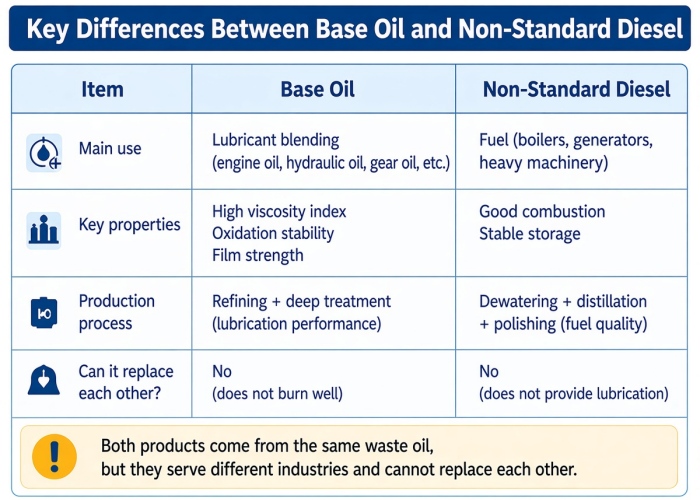
Key different between base oil and non-standard diesel
Before comparing quotations, answer three questions. They settle the choice more often than any brochure does.
What is your end product: fuel to burn on site, fuel to sell locally, or stock for a lubricant plant? A refining machine is priced and configured around the first two. The third needs a different process and a much longer approval path.
Does your local authority allow the way you plan to use and sell non-standard diesel? Permits for storage, transport and sale vary by region, and a machine that runs well can still sit idle if the output has no legal route to market.
What is actually in your feedstock, in volume, water content and impurities? Two suppliers of waste engine oil can deliver very different feeds, and the water and solids load decides how much pre-treatment the line needs before distillation.
| Your goal | Better direction | Why |
|---|---|---|
| Turn waste engine oil into industrial fuel for own use or local sale | Waste engine oil refining machine | Output is non-standard diesel for boilers, heavy machinery and generators |
| Upgrade pyrolysis oil or seek higher diesel quality | Catalytic distillation route with a solid catalyst | Avoids the acid-alkali wastewater of the traditional liquid acid-alkali route |
| Supply lubricant blenders with base oil | A dedicated base oil regeneration process, not this machine | Base oil specifications require a different class of plant |
DOING ECO supplies both routes: the traditional acid-alkali refining line with clay polishing and the solid-catalyst catalytic distillation line, in capacities from around 100 kg to 30 t/d per line. A 14 t/d waste engine oil refining line built for a customer in West Kalimantan, Indonesia was commissioned in July 2023 and serves local fuel distribution and plantation operations.
No. It is a fuel oil for boilers, heavy machinery and diesel generators, and it does not meet road diesel specifications. It should not go into the tank of an ordinary car or light truck; the engines that run it well are the ones built for continuous heavy duty.
A heavy residue similar to asphalt, which can be sold as fuel, and a small stream of combustible gas that is recycled to heat the plant. That gas loop is what keeps the external fuel demand of the line low.
Yes. Water content, light impurities and the type of contamination all affect how the oil distills and which fraction you get. A sample test before purchase settles the process route and gives a realistic picture of the output.
Acid-alkali refining is the traditional route with lower upfront investment, but it produces acid-alkali wastewater that needs treatment. Catalytic distillation uses a renewable solid catalyst, avoids that wastewater stream and gives higher diesel quality. Local environmental rules and your feedstock usually decide.
Send a sample for small-scale laboratory testing. The test shows how the oil behaves in distillation and what a realistic output looks like, and the process proposal is built on those results rather than on assumptions.
Send your waste engine oil sample, daily tonnage and target use. We will reply with the process route that fits, a machine and component list, and a layout proposal for your site.
Leave A Message
Leave A Message