Professional·One-stop Services
Get customized solution and favorable quotes here: +86 13526692320

Continuous pyrolysis plants usually lose uptime for a few recurring reasons: unstable feeding, coke or wax accumulation, sealing and pressure problems, and condensation or gas-handling issues. Another important risk is how quickly the system and operators respond when conditions move outside the normal operating range.
These are usually system-level problems rather than failures of one component. A 50 TPD reactor rating does not by itself prove that the complete line can maintain stable operation when feedstock conditions change or residue accumulates.
DOING ECO’s project experience includes 50 TPD continuous tire pyrolysis equipment and a 2 × 50 TPD continuous tire pyrolysis project. For a buyer, the practical sequence is simple: define the prepared feedstock, identify the likely failure points, compare how the design controls them, and verify the supplier with comparable project evidence.
Continuous pyrolysis depends on consistent feeding. Before comparing reactor designs, define what will actually enter the reactor after pretreatment.
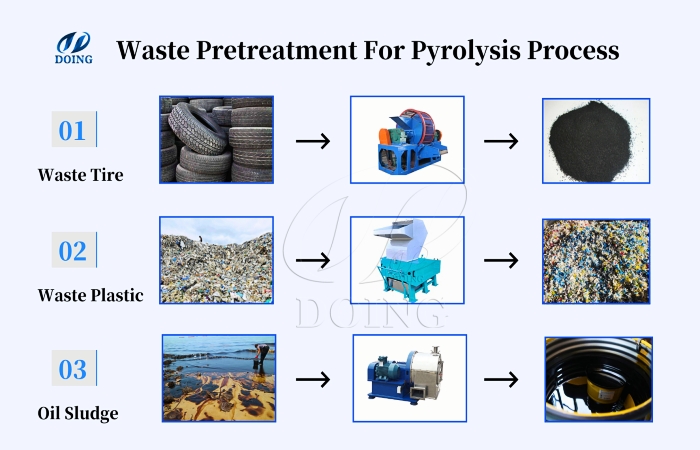
For continuous tire pyrolysis, prepared rubber is required rather than whole tires. Particle size, moisture, steel content and other impurities can affect the feeding system and downstream process.
DOING ECO’s continuous tire solutions are specified around approximately 2–20 mm prepared rubber particles or powder, with bead-wire removal and magnetic separation before feeding. For other feedstocks, pretreatment requirements differ: waste plastics may require sorting, shredding and removal of unsuitable materials, while oil sludge may require moisture control and removal of large impurities. These are feedstock-specific requirements rather than universal standards and should be confirmed against the actual feeding and pyrolysis system
| Feedstock condition | What to verify |
| Particle size | Whether the feeder accepts the actual prepared size |
| Moisture | Whether drying is required and how it affects throughput |
| Steel and impurities | Separation method before continuous feeding |
| Feedstock composition | Compatibility with the reactor and gas system |
| Daily supply | Whether available prepared feedstock supports the planned TPD |
The key point is simple: size the continuous line around the prepared feedstock you can supply consistently, not only around the reactor nameplate.
Once the feedstock is defined, focus on the parts of the process where instability can lead to an unplanned stop.
Inconsistent particle size, excessive impurities or poorly matched pretreatment can cause bridging, uneven feeding or overload of the feeding mechanism.
The supplier should explain the complete path from pretreatment to reactor inlet, including how the system handles changes in feed rate or a feeder stop.
Some pyrolysis vapors contain heavier components that can condense or accumulate when temperature conditions are unsuitable. This can restrict the vapor path, increase pressure and create additional cleaning work.
Instead of simply asking whether a system is “anti-coking,” ask where buildup is expected, how it is controlled, and how the affected section can be cleaned.
For relevant continuous pyrolysis designs, DOING ECO can use a wax-removal tank and catalyst to help reduce wax accumulation and improve the quality of the pyrolysis oil, together with a dedicated coke-removal structure to deal with coke buildup. The specific configuration and maintenance method should be confirmed for the actual feedstock and project.
Pyrolysis operates under oxygen-deficient conditions and produces combustible gases. Pressure control and sealing therefore affect both process stability and safe operation.
The design should provide a clear approach to pressure monitoring, air-ingress control, abnormal conditions and shutdown procedures.
DOING ECO continuous systems can be configured with PLC control, nitrogen purging and negative-pressure sealing. In the 2026 Poland project with 2 × 50 TPD continuous tire pyrolysis plants, the system used this sealing approach together with PLC-based monitoring and automatic alarm and interlock protection. This is a project-specific configuration, not a universal requirement for every continuous pyrolysis plant.
The reactor should not be evaluated separately from the condensation and gas systems.
Pyrolysis produces liquid, gas and solid fractions. The gaseous fraction can contain combustible components and may be reused as process fuel when the system is designed for it.
A condensation problem can therefore affect more than oil recovery. It can also influence gas pressure and downstream operation.
When comparing suppliers, ask to see the complete vapor condensation, gas separation, gas recycling and exhaust-treatment path.
The useful comparison is not which reactor looks more advanced. It is how the design controls the failure points identified for your feedstock and operating conditions.
| Risk area | What to compare | Evidence to request |
| Feeding | Pretreatment, particle size and feeding method | Feedstock test or operating case |
| Coking/wax | Temperature control and vapor-line design | Process description and cleaning method |
| Pressure/sealing | Sealing, pressure control and purge arrangement | P&ID or control logic |
| Gas handling | Separation, recycling and emergency handling | Gas-system diagram |
| Abnormal conditions | Sensors, alarms and shutdown sequence | Control logic or cause-and-effect |
| Maintenance | Access to residue-prone and wear components | Layout and maintenance procedure |
A supplier with continuous operating experience should be able to explain what happens when the process leaves its normal operating range, not only how the plant performs under design conditions.
Section 3 shows what to compare in the design. Before ordering, turn those risk areas into specific questions and ask suppliers to provide supporting evidence.
Ask:
What feedstock preparation and particle-size range are required?
How is wax or coking controlled, and how is the affected section cleaned?
How is reactor pressure monitored and air ingress controlled?
What happens when temperature or pressure moves outside the operating range?
Is nitrogen purging included where required, and what is the shutdown sequence?
How is pyrolysis gas separated, recycled and treated?
What maintenance is planned, and which parts require scheduled replacement?
Can you provide a comparable operating project?
Do not treat “fully automatic” as technical evidence. Ask what the PLC monitors, which alarms stop feeding or heating, which components require manual inspection, and what maintenance is expected for residue-prone sections.
For DOING ECO, relevant first-party evidence includes feedstock-preparation requirements, control-system configuration, gas-system configuration, maintenance access and comparable continuous tire projects, including the 50 TPD and 2 × 50 TPD projects described above.
The same evidence should be requested from other suppliers so the comparison is based on engineering information rather than marketing language.
How can I reduce downtime in a continuous pyrolysis plant?
Start with consistent prepared feedstock, then verify feeding, residue control, condensation, sealing and maintenance access as one system. Ask for the planned cleaning intervals and wear-part replacement schedule for the specific line.
Is continuous pyrolysis safer than batch pyrolysis?
The operating mode alone does not establish safety. Safety depends on factors such as sealing, pressure control, gas handling, interlocks and operating procedures.
How often does a continuous pyrolysis plant need maintenance?
There is no single maintenance interval for every feedstock and design. Request the planned schedule for cleaning, seal inspection and wear-part replacement for the quoted equipment.
What particle size is required for continuous tire pyrolysis?
DOING ECO’s continuous tire solutions are specified around approximately 5–20 mm prepared rubber particles or powder, after bead-wire removal and magnetic separation. Confirm the range against the actual feeding system before fixing the plant capacity.
If you are evaluating a continuous pyrolysis project, start with four inputs: feedstock type, prepared particle size, target TPD and project location.
DOING ECO can use these conditions to review the required pretreatment, feeding, pyrolysis, condensation and gas-handling configuration before the equipment specification is finalized.
Leave A Message
Leave A Message