Professional·One-stop Services
Get customized solution and favorable quotes here: +86 13526692320

Biochar safety comes down to one question: are PAHs present? Polycyclic aromatic hydrocarbons form when organic matter pyrolyzes incompletely, and they're the top contaminant concern for regulators and buyers worldwide.
DOING ECO sent biochar produced by our biomass carbonization machine to SGS for independent PAHs testing. Out of 16 compounds, 15 were not detected. Benz(a)pyrene—a Group 1 carcinogen—was also ND. Here's what the results mean for your business. The resulting charcoal produced by the DOING biomass carbonization machine meets strict environmental standards for sensitive applications such as soil amendment and agriculture.
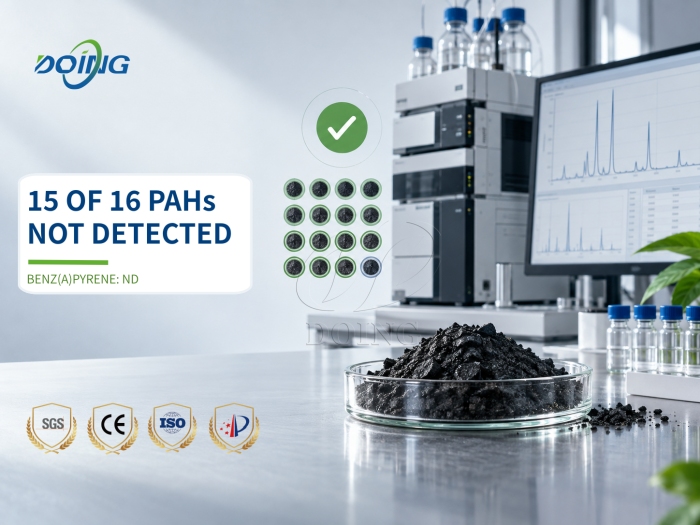 SGS certified biochar production process
DOING ECO (Henan Doing Environmental Protection Technology Co., Ltd.) submitted a biochar sample to SGS for PAHs testing. The lab followed HJ 892-2017, China's national standard for determining PAHs in solid waste using high-performance liquid chromatography, combined with the HJ/T 299-2007 leaching methodology. The test covered 16 PAH compounds. Results are summarized below.
| Field | Value |
|---|---|
| Report No. | SHE26-C07001R01_CN |
| Testing Laboratory | SGS (Transs Standard Technical Services Co., Ltd.) |
| Client | DOING ECO (Henan Doing Environmental Protection Technology Co., Ltd.) |
| Sample | Biomass Charcoal |
| Sample Matrix | Solid Waste |
| Testing Standard | HJ 892-2017 (HJ/T 299-2007 leaching method) |
| Testing Period | Sep 5 – Sep 15, 2026 |
| Report Date | Sep 15, 2026 |
| PAHs Tested | 16 compounds |
| Not Detected (ND) | 15 |
| Detected (at detection limit) | 1 – Phenanthrene (0.01 μg/L) |
| Benz(a)pyrene (IARC Group 1 Carcinogen) | ND |
| Method Blank | All within control range |
| Lab Control Sample | 61.4%–84.2% recovery |
| Lab Parallel Sample | All within control range |
| Matrix Spike | 50.5%–72.3% recovery |
| Sample Surrogate | 67.7% recovery (perfluorobiphenyl) |
All quality control measures passed. Method blanks showed no contamination. Lab control samples returned 61.4%–84.2% recovery, well within the 50%–120% acceptance range. Matrix spikes averaged 50.5%–72.3%. The surrogate compound, perfluorobiphenyl, recovered at 67.7%. Every control measure confirms the data's reliability.
European and North American markets are tightening PAH limits on soil amendment products. The EU's REACH regulation and the US EPA's taint rule both flag PAHs as priority pollutants. When your biochar tests clean, you clear a regulatory hurdle that competitors can't.
Beyond compliance, clean biochar opens higher-value applications. Farmers and landscapers can apply it in organic certification programs and food-grade crop production without worrying about contaminant buildup in topsoil. That single result expands your addressable market significantly.
Third-party validation also matters for ESG reporting. Buyers in the carbon credit space demand verifiable data. SGS certification gives you audit-ready documentation for supply chain due diligence, which many enterprise purchasers now require.
Finally, this result reflects your equipment's process control. Consistent temperature management during pyrolysis prevents PAH formation at the source. That's not luck—it's engineering, and it's what separates DOING ECO's continuous double-layer carbonization machine from other biomass pyrolysis units that struggle with uniformity.
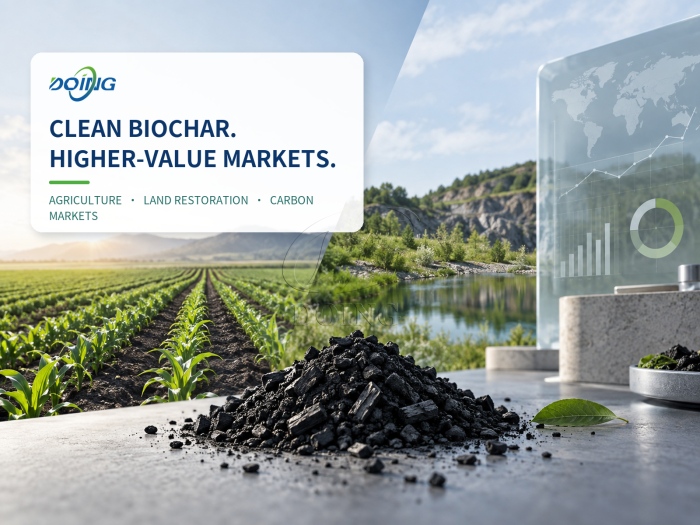 Carbonization biochar high value applications
DOING ECO's continuous double-layer carbonization machine operates at 400–700°C under oxygen-free conditions. The double-cylinder design feeds heat from the outer chamber into the inner biomass pyrolysis chamber, creating a self-sustaining thermal loop that cuts external energy demand by up to 90%. A PLC control system monitors temperature in real time, adjusting feed rate and airflow to keep the reaction zone stable.
The result is biochar with an H/C organic molar ratio below 0.3—well within the range for stable, long-term carbon sequestration. PAHs form when organic matter pyrolyzes too slowly or at temperatures that allow incomplete decomposition. DOING ECO's rapid, uniform heating cycle pushes material through the danger zone quickly, leaving little time for PAHs to form.
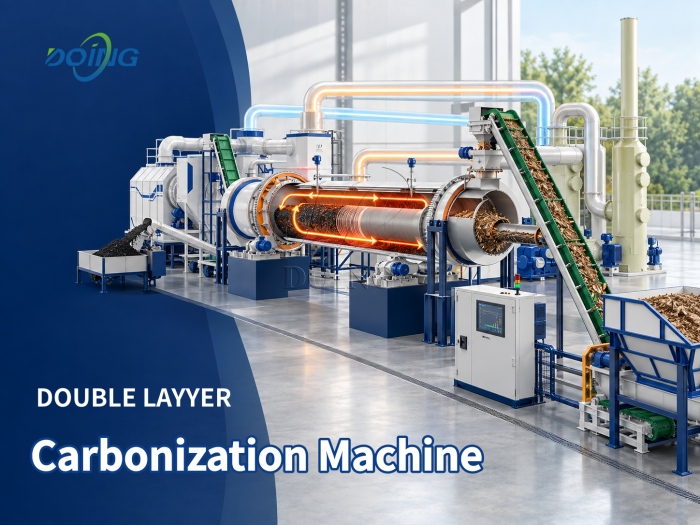 DOING double-layer continuous carbonization machine
ND stands for "Not Detected." It means the PAH concentration fell below the instrument's detection limit. In practical terms, the compound is either absent or present at a level too low to measure.
Yes. With 15 of 16 PAHs undetected and benz(a)pyrene—a known carcinogen—also ND, the biochar meets the safety threshold for soil application. It is suitable for crop production, landscaping, and land reclamation.
The continuous double-cylinder carbonizer handles sawdust, rice husks, coconut shells, bamboo chips, and other biomass waste. Feedstock size should be under 10 mm, with moisture content below 15%.
Yes. DOING ECO sends engineers to your site for installation and commissioning. We also provide remote troubleshooting, spare parts shipping, and operator training as part of our EPC package. With over 15 years of experience as of 2026, DOING ECO has delivered projects to 120+ countries across four continents.
Want the full SGS report or a custom biochar production plan? Contact DOING ECO for a custom biochar production plan. Our engineers will share the complete test data and design a solution for your biomass pyrolysis feedstock and capacity needs.
Leave A Message
Leave A Message