Professional·One-stop Services
Get customized solution and favorable quotes here: +86 13526692320

When investing in a waste pyrolysis project, many customers focus primarily on equipment price. However, the lowest-priced machine does not always deliver the best return. Production capacity, energy consumption, maintenance requirements, labor costs, and feedstock conditions all directly affect the project's long-term profitability.
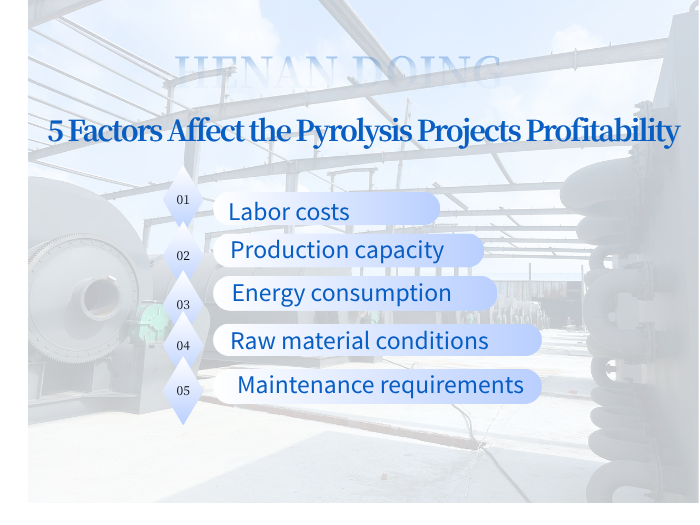 Factors affecting the profitability of waste pyrolysis equipment
The most cost-effective pyrolysis machine is not necessarily the cheapest one, but the one that best matches your production requirements, investment budget, and future expansion plans.
For most small and medium-sized projects, batch-type and semi-continuous pyrolysis machines provide the most practical solution. They offer a good balance between investment and productivity, while fully continuous systems are better suited for large-scale industrial operations with higher capacity requirements.
Based on years of engineering experience and real project applications, DOING classifies pyrolysis equipment into three main types: batch-type, semi-continuous, and fully continuous pyrolysis machines.
| Type | Initial Investment | Daily Capacity | Operation Mode | Suitable Projects |
| Batch-type | Low | 1-20 tons | Intermittent operation | New investors and small-scale projects |
| Semi-continuous | Medium | 5–20 tons | Regular feeding and discharge | Commercial recycling projects |
| Fully continuous | High | 15-50 tons | 24/7 continuous operation | Large-scale industrial facilities |
Batch-type pyrolysis equipment is the most economical option for investors entering the waste recycling industry with limited capital. It uses batch feeding and completes one production cycle before cooling, residue discharge, and reloading.
The equipment is easy to operate and can adapt to a relatively wide range of feedstock conditions. It is commonly used for projects with daily processing capacities of 10, 12, or 15 tons.
Compared with conventional batch machines that often require around 10 hours for cooling, DOING's improved design reduces cooling time to approximately 3–4 hours, helping shorten production cycles and improve daily productivity.
For projects requiring a smaller processing capacity, DOING also provides frame-type pyrolysis equipment. This compact configuration has a smaller processing capacity, a simple structure, and convenient installation. It is suitable for feasibility studies, basic experiments, and small-scale testing before commercial production.
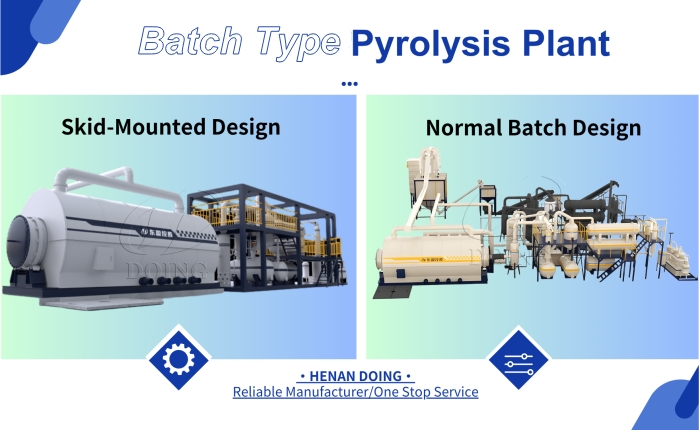 Henan DOING Skid-mounted vs batch-type Equipment
Recommended for:
1.New pyrolysis projects
2.Small and medium-sized investors
3.Projects with flexible feedstock supply
4.Customers seeking lower initial investment
5.Feasibility studies and basic experimental projects with small processing requirements
Semi-continuous pyrolysis equipment is an ideal choice for investors who need higher output without investing in a fully continuous production line.
It is equipped with a sealed screw feeding system and high-temperature direct slag discharge technology, allowing feeding and residue removal without waiting for the reactor to cool completely.
Proper feedstock preparation is required:
Waste tires should be shredded into particles of 20 mm or smaller
Plastic waste should be processed into suitable flakes
Compared with batch systems, semi-continuous equipment offers higher automation, better energy utilization, and improved production efficiency while maintaining a reasonable investment level.
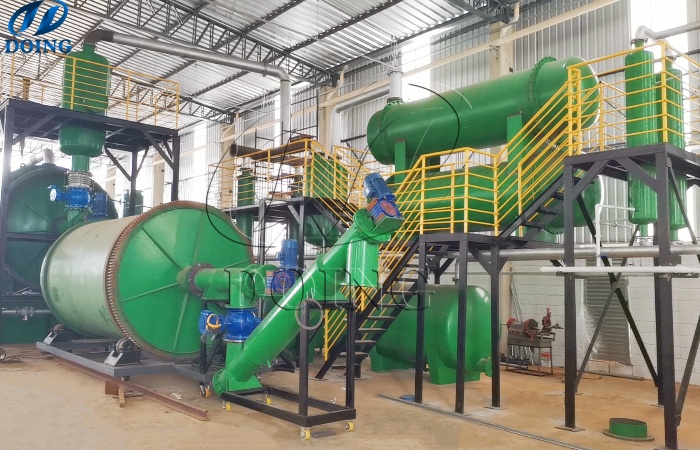 Best cost performance semi-continuous tire pyrolysis equipment
Recommended for:
1.Commercial recycling projects
2.Medium-scale production
3.Investors planning to expand production capacity
Fully continuous pyrolysis equipment is designed for industrial-scale operations that require stable, uninterrupted production.
It supports continuous feeding and slag discharge, with a single operating cycle typically lasting 45–60 days. Daily processing capacity usually starts from 15-50 tons
Its main advantages include:
1.Continuous and stable production
2.Higher production efficiency
3.Lower energy consumption per ton
4.Reduced labor costs
5.More consistent product quality
Because of its high level of automation and production capacity, this type of equipment is generally selected for projects with reliable raw material supply and long-term production plans.
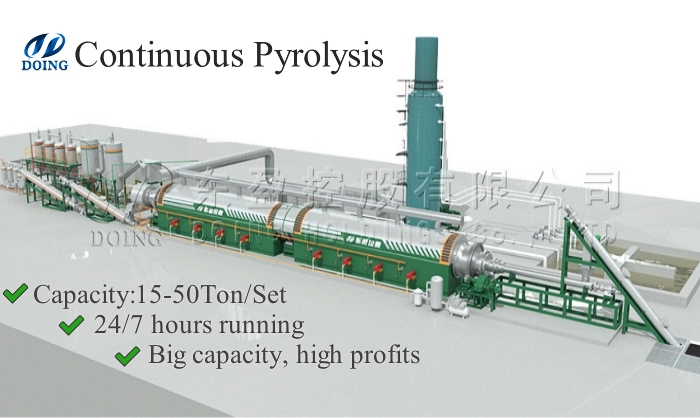 Henan DOING advantages of fully continuous pyrolysis equipment
Recommended for:
1.Large waste treatment companies
2.Industrial-scale recycling facilities
3.Long-term commercial recycling projects
The right equipment depends on your production goals, investment budget, and feedstock supply.
1.Daily capacity around 1–15 tons with a limited budget:
Batch-type equipment is usually the most economical choice.
2.Need higher efficiency while controlling investment:
Semi-continuous equipment is often the most practical option.
3.Large-scale production with stable raw material supply:
Fully continuous equipment delivers the highest long-term operating efficiency.
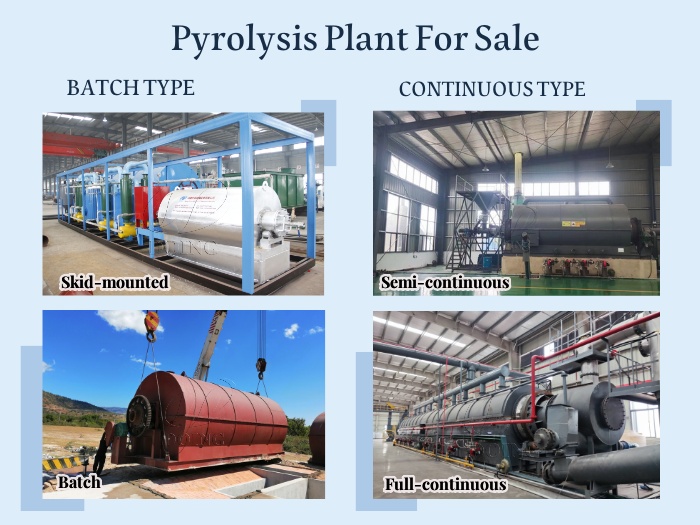 Different types of pyrolysis equipment for sale
DOING provides customized pyrolysis solutions based on different feedstock types, processing capacities, and customer requirements.
With extensive experience in waste tire pyrolysis, plastic pyrolysis, and waste oil sludge recycling projects, DOING helps customers select suitable equipment configurations according to production requirements, local conditions, and investment goals.
Our advantages include:
Customized equipment design for different applications
Flexible heating solutions based on local fuel availability
Integrated environmental protection systems, including dust removal and desulfurization
Professional installation guidance and technical support
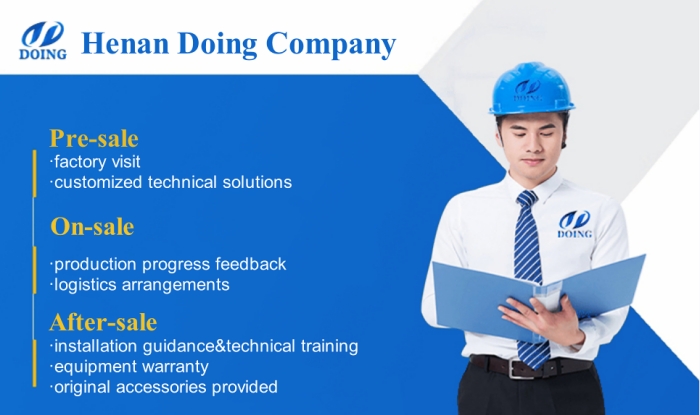 End-to-end services provided by Henan DOING
There is no single pyrolysis machine that is suitable for every project. The best choice depends on your processing capacity, feedstock characteristics, investment budget, and future production plans.
If you are unsure which type of equipment is right for your project, DOING can provide a customized technical solution and detailed equipment quotation based on your specific requirements.
Leave A Message
Leave A Message