Professional·One-stop Services
Get customized solution and favorable quotes here: +86 13526692320

The sustainable utilization of agricultural waste has become an increasingly important topic as industries seek cleaner energy solutions and governments promote circular economy practices. One of the most effective and environmentally responsible ways to reuse agricultural residues is through their conversion into solid fuel in the form of charcoal. With the right approach, agricultural waste can be sustainably converted into charcoal, turning low-value byproducts into a stable, high-carbon energy source.
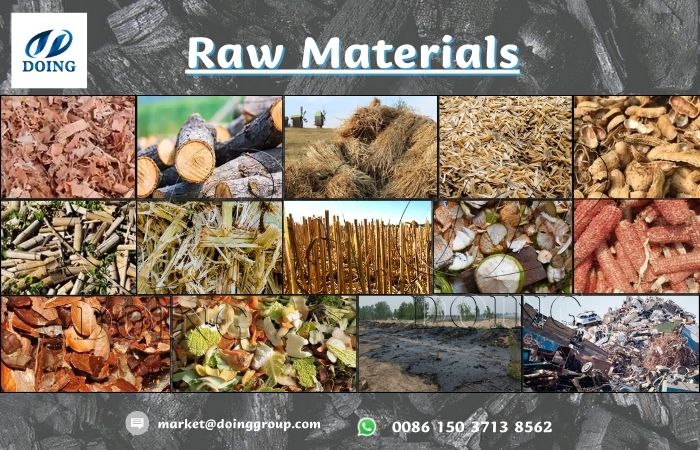 Carbonizable agricultural waste raw materials
Agricultural waste such as rice husks, coconut shells, palm shells, sawdust, corn cobs, and bamboo contains high levels of carbon and lignocellulosic material, making it an ideal feedstock for charcoal production. Through a controlled carbonization process, these materials are thermally decomposed in an oxygen-limited environment, converting biomass into high-carbon solid fuel while minimizing emissions. The underlying principle is quite simple: when biomass is heated, volatile components are released, and the remaining carbon structure rearranges into a denser and more stable form. This is why the final product has a higher energy density and burns longer than raw biomass.
When it comes to carbonization equipment, DOING's agricultural waste pyrolysis carbonization equipment is designed to handle this process in a clean and efficient way. Our carbonization equipment employs a low-temperature, slow-pyrolysis process—integrating a hot-air furnace, a drying kiln, and a dual-drum carbonizer—and is equipped with an intelligent temperature control system. This configuration enhances the overall polycondensation reactions during the carbonization of agricultural biomass, thereby boosting the energy density and fuel quality of the resulting charcoal. The soild fuel — charcoal/biochar produced through this process exhibits a significantly elevated calorific value (reaching 25–35 MJ/kg, comparable to coal); furthermore, it burns smokelessly with a stable flame, making it convenient for both storage and transport. Besides that, the agricultural biomass waste carbonization system recovers combustible syngas produced during carbonization and sends it back to the heating chamber to lower fuel consumption. And we have related exhust gas purification system and dedusting system to ensure the environmental standard emission.
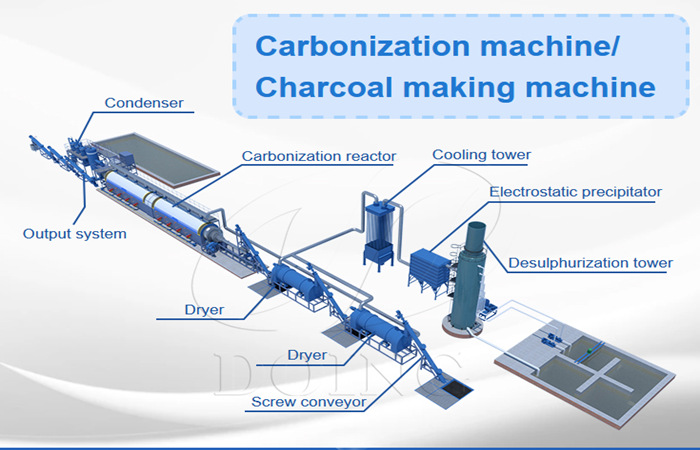 DOING's agricultural waste pyrolysis carbonization equipment
Compared with open-pit or earth kiln methods, this setup improves efficiency, cuts down smoke and tar emissions, and makes the whole operation more practical for everyday use. DOING offers both continuous-feed and batch-type systems, so customers can choose what fits their scale and operation.
The resulting charcoal offers several advantages over conventional fossil fuels. It has a higher fixed carbon content, lower ash and burns more cleanly. These properties make biomass charcoal suitable for industrial boilers, metallurgy, barbecue fuel, and as a precursor for activated carbon production. In addition, charcoal derived from renewable biomass contributes to carbon neutrality by recycling atmospheric CO₂ absorbed during plant growth. For agricultural regions, converting waste into charcoal also brings economic benefits. It reduces disposal costs, prevents open-field burning, and creates new revenue streams for farmers and processing facilities. In fact, when agricultural waste is converted into solid fuel through a proper carbonization system, a farm or processing plant can turn a disposal problem into a steady source of income. This is especially valuable in areas where open burning is being phased out due to stricter environmental regulations.
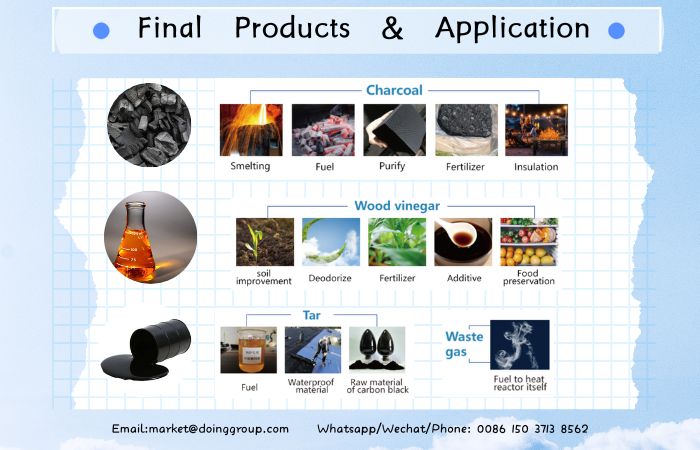 Agricultural waste carbonization final products and applications
Beyond the equipment itself, DOING offers practical support that makes a real difference for buyers. Installation guidance, operator training, and after-sales technical assistance are all part of what customers get. For someone new to this type of agricultural waste pyrolysis carbonization equipment, having a team that answers questions and helps troubleshoot issues means less downtime and a smoother start. That kind of support matters, especially when you are running a continuous operation that needs to stay online to be profitable.
As demand for sustainable energy continues to grow, charcoal production from agricultural waste represents a practical, scalable, and environmentally responsible solution. If you are looking into setting up or upgrading a carbonization system for agricultural residues, feel free to get in touch. We can talk about your feedstock, expected output, and what kind of setup makes the most sense for your situation.
Leave A Message
Leave A Message