English
 Русский
 Français
 Español
 Tiếng Việt
 한국인
한국인 日本語
日本語 แบบไทยไทย
 Indonesia
 Deutsch
 Português
 عربي
عربي हिन्दी
 Українська
 Türkçe
 Malaysia
 Italiano
Professional·One-stop Services
Get customized solution and favorable quotes here: +8613526692320

Most waste plastics can be refined through waste plastic pyrolysis plants, such as PP, PE, PS, ABS, white plastic sheets, plastic bags, scraps from paper mills, plastic household waste, plastic cable sheaths, etc. However, the final oil yield of waste plastic pyrolysis plant is not static, varying from 40% to 90%. This means you can extract about 400kg-900kg pyrolysis oil(350-850 liters of oil) from 1 ton waste plastic. The oil yield of waste plastic pyrolysis plant is directly linked to the types of waste plastic and pyrolysis plant configurations.
 Convert plastic to fuel oil pyrolysis plant
Firstly, different materials have different oil output rates. For example, PE,PP and PS all have 50%-70% oil output rate, while ABS has 40%. And other suitable feedstocks of plastic pyrolysis machine include: agricultural plastic mulching film (oil yield: 50–70%), woven plastic bags (oil yield: 40–70%), medical plastic waste (e.g., PP and PE IV bags, with an oil yield reaching 60–75%), epoxy resins (oil yield: 40–50%), aluminum-plastic laminates (oil yield: 30–50%), and household plastic waste (oil yield: 20–30%), etc.
Secondly, the output rate of plastic pyrolysis oil machine also differs according to water percentage. For example, wet leftovers of paper have 15-20% oil output rate, while dry leftovers of paper have 60%. Furthermore, when collecting plastic waste, in addition to minimizing moisture content, it is essential to minimize other impurities—such as soil and other contaminants—as much as possible.
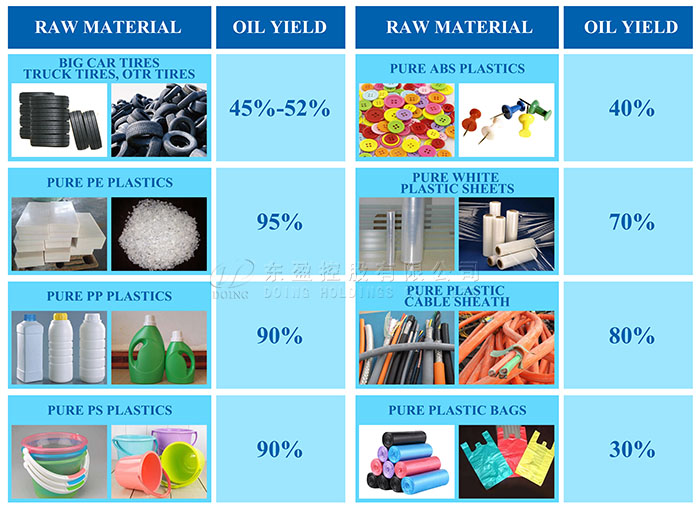 Different plastics has different oil yield
Moreover, the configurations of the waste plastic pyrolysis plant also influence the oil output. We have two operating systems, batch pyrolysis system and continuous pyrolysis system. The feedstock requirements for both semi-continuous and fully continuous pyrolysis equipment specify the use of shredded plastics or plastic granules. Shredding the plastic increases its specific surface area, thereby ensuring more uniform heating and accelerating the pyrolysis process. Compared with batch pyrolysis system, the continuous pyrolysis system has higher oil yield and can run for 24 hours per day without stopping, while simultaneously reducing quality fluctuations in plastic pyrolysis oil across different batches.
 Batch continuous waste plastic pyrolysis plants
In addition, for the waste plastic pyrolysis plant, the cooling system is very important, which is closely related to the oil yield rate. Therefore, oil yield rate can be guaranteed if the cooling effect is better. Our company has achieved a big success in the cooling system after several years of research and improvement. In the latest design of DOING waste plastic pyrolysis machines, we have incorporated highly specialized, industrial-grade condensers, thereby enabling the complete extraction of fuel oil from waste plastics. Whether utilizing shell-and-tube condensers or tank-based condensers, our systems feature multi-stage piping configurations that maximize the contact surface area between the pyrolysis oil vapors and the condensing tubes, ensuring that the oil vapors are thoroughly cooled and converted into liquid oil. Moreover, the entire pyrolysis oil condensing system employs a circulating water cooling process; by harnessing the heat-exchange properties of the circulating water to continuously dissipate heat, the system facilitates the stable conversion of oil vapors into liquid oil, thereby minimizing vapor loss and maximizing oil recovery rates.
 Two kinds of cooling system of plastic pyrolysis machine
Fuel derived from plastics pyrolysis process—commonly referred to as "plastic oil"—serves a wide variety of purposes within the industrial sector. Boasting a high calorific value ranging from 10,000 to 10,300 kcal, and characterized by low ash content and suitable viscosity, plastic oil is frequently utilized as boiler fuel/furnace fuel in industrial settings such as steel mills, cement plants, and ceramics factories, where it provides the thermal energy required for high-temperature smelting and calcination processes. In the realm of energy substitution, plastic oil can undergo advanced processing—including distillation and decolorization—to yield approximately 85% non-standard diesel. This fuel is suitable for powering large vessels, agricultural machinery, and heavy construction equipment, thereby effectively alleviating pressure on conventional diesel supplies. The remaining 10% to 13% consists of asphalt byproducts, which can be utilized in road construction, thereby realizing the comprehensive utilization of waste plastic scrap.
 Waste plastic pyrolysis oil usages
For more information about our high oil yield waste plastic pyrolysis plant, feel free to consult Henan Doing Company at any time. Our professional sales team and engineer team offer professional solutions to help you obtain high profits from investment!
contact us
CONTACT US